Frozen evidence
Visual and textual encoders remain fixed; adaptation is confined to a lightweight fusion module.
ACM Multimedia 2026 · MM ’26
1 Guangdong University of Technology · 2 Sun Yat-Sen University
Reliability-aware fusion for multimodal test-time adaptation under modality-specific shift.
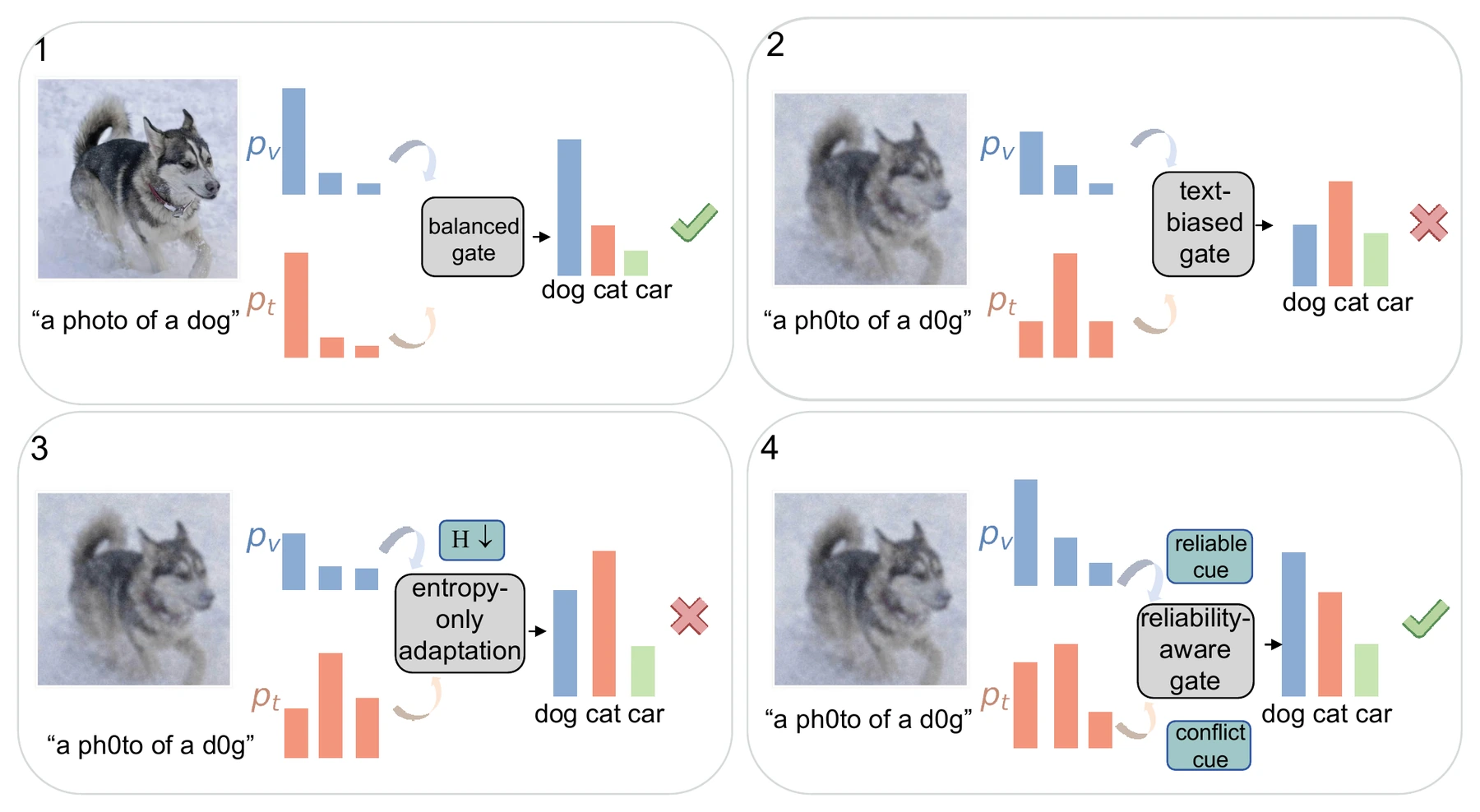
Vision-language models can face asymmetric visual and textual shifts at deployment. These shifts expose a multimodal failure mode in which an unreliable branch remains overconfident, dominates fusion, and causes entropy-based test-time adaptation to sharpen an incorrect prediction. We model this behavior as doubly stochastic posterior mixing and cast adaptation as constrained de-mixing.
MG-MTTA freezes both encoders and updates only a lightweight fusion module. Running-anchor consistency estimates relative branch drift, while cross-modal conflict regulates modality dominance before entropy sharpening. On ImageNet, MG-MTTA improves top-1 accuracy from 57.97% to 66.51% under textual shift and from 21.68% to 26.27% under joint shift.
MG-MTTA separates modality selection from confidence improvement: the fusion gate controls which branch should dominate, then entropy minimization sharpens the fused posterior.
Visual and textual encoders remain fixed; adaptation is confined to a lightweight fusion module.
Running-anchor consistency tracks branch drift, while JS and ranking disagreement capture cross-modal conflict.
A soft gate prior limits unreliable modality dominance before posterior sharpening.
hf = αhv + (1 − α)htℒ = ℒent + λgℒgate + λdℒdivScope. MG-MTTA controls late fusion and complements representation-level adaptation; it does not reconstruct evidence already lost inside an encoder.
@inproceedings{chen2026mgmtta,
  title     = {Majorization-Guided Test-Time Adaptation for Vision-Language Models under Modality-Specific Shift},
  author    = {Chen, Lixian and Huang, Mingxuan and Chen, Yanhui and Lin, Junyi and Shi, Yang},
  booktitle = {Proceedings of the 34th ACM International Conference on Multimedia},
  year      = {2026},
  doi       = {10.1145/3767308.3836429}
}